The Trial Piece: Turning Bespoke Metalwork Assumptions into Agreed Fact
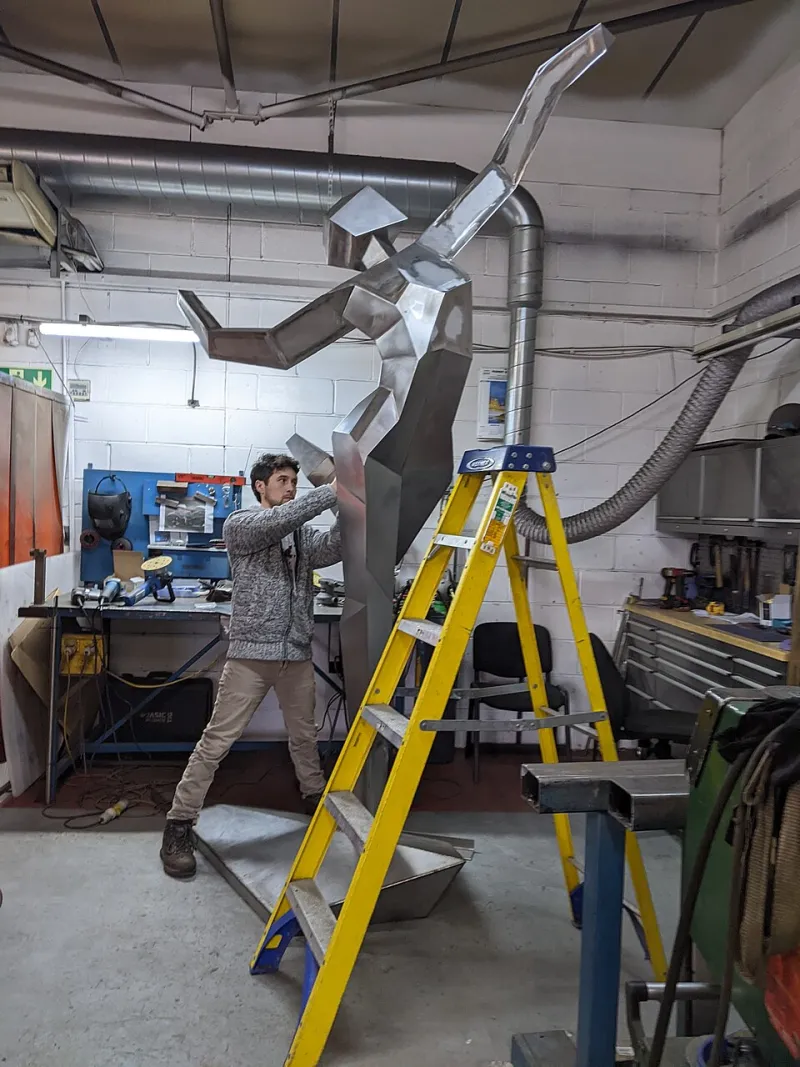
Photo: The Artist 26, CC BY-SA 4.0, via Wikimedia Commons
Bespoke fabrication rarely comes apart at the drawing board. It comes apart at the junction: where a new balustrade meets a screed that is 12 mm out, where a fabricated frame lands on holding-down bolts set by others, where a specified finish reads differently under a north-facing sky than it did on a swatch. Drawings describe intent. A physical mock-up describes reality, and that difference is what a trade buyer is paying to discover early.
What a trial piece is, and what it is not
A mock-up in the sense discussed here is not a material sample, nor a colour chip, nor a rendered visual. It is a fabricated element — full size, or a representative section of one — built with production tooling, production labour and production finishes, then tested against the things that will actually determine whether the package succeeds on site.
It is also not a prototype in the research sense. The design is not in question; the design is fixed. What is in question is whether the fixed design survives contact with the building, the adjacent trades, the inspection regime and the weather.
Where the budget is justified
Not every order warrants a trial piece, and a fabricator who recommends one for every job is not offering good value. The case tends to rest on a small number of signals.
The first is interface complexity. Where new metalwork meets existing structure — a retrofit stair, a balustrade following an out-of-square opening, a canopy tied into masonry of uncertain date — the number of unknowns is high and the cost of discovering them after fabrication is higher.
The second is repetition. A single bespoke gate can be corrected on site at modest cost. A hundred identical balustrade panels, or twenty window surrounds, cannot. The mock-up becomes the reference against which the run is judged, and the earlier that reference exists, the cheaper each subsequent unit becomes.
The third is finish criticality. External steelwork in the UK is asked to survive driven rain, coastal chloride, de-icing salts and long periods of low UV. Whether a galvanized and powder-coated assembly drains properly, whether welds dress cleanly enough for a visible location, whether a patinated finish is consistent across a welded joint — these are questions best answered on one piece rather than on a completed elevation.
The fourth is handling and access. A mock-up can be used to rehearse the lift, the temporary support, the sequence of fixing and the clearance needed for a spanner. On constrained urban sites, this alone can justify the exercise.
What the piece should prove
A mock-up without a test schedule is an expensive ornament. The schedule should be agreed before fabrication begins, and it should cover at least five areas.
Dimensional behaviour: not just nominal sizes, but how the element behaves when assembled under its own weight and fixed at realistic positions. Tolerances should be referenced to the project specification and, where applicable, to the execution class declared for the work under BS EN 1090-2.
Connection geometry: hole sizes, slotting, packer allowances and the practical swing of a bolt or the travel of an anchor. A connection that is theoretically correct but impossible to tighten is a site problem waiting to happen.
Finish performance and appearance: coating thickness readings, adhesion, coverage at edges and inside corners, and a viewed assessment in the location and light conditions the finished work will occupy — not under workshop floodlights.
Adjacent interfaces: the mock-up should include, or be offered up to, representative samples of the materials it will meet — stone, concrete, glazing, cladding, soffit — so that gaps, sealant joints and cover pieces are resolved on the bench rather than in a cradle.
Installation and maintenance: how the piece is handled, whether it can be adjusted after fixing, and whether the fixings remain accessible for later inspection.
Making it a formal instrument
The value of a mock-up is multiplied when it is treated as a contractual reference rather than a workshop experiment. That means a documented sign-off: a dated record of the piece inspected, the attendees, the observations, the agreed amendments and the disposition of any deviation.
The sign-off should involve the parties who will later accept the work — the main contractor, the designer or architect, and, where relevant, the client representative or building control. A mock-up approved only internally carries little weight when a dispute arises about what 'to match approved sample' was meant to mean.
It is also worth deciding, at the outset, what happens to the piece afterwards. Some mock-ups are incorporated into the permanent works; others are retained as a benchmark and stored; others are destroyed. Each option carries a cost and a risk, and the choice should be recorded rather than left to the end of the job.
The cost question
Trade buyers often treat the mock-up as an avoidable overhead. It is better understood as an insurance premium with a known price. The cost is usually a small fraction of the package value, comprising design time, material, fabrication, finishing, inspection and storage.
Against that, the alternative is rework. Rework on a fabricated and finished steel element is rarely a matter of a small adjustment; it usually involves removal, transport, stripping of coating, re-fabrication, re-finishing and reinstallation, with programme consequences that dwarf the original cost.
A closing note on discipline
The discipline a mock-up imposes is as valuable as the artefact itself. It forces the parties to agree what 'acceptable' means before there is any commercial pressure to accept what has been made. For complex bespoke packages, that early clarity is usually the most durable thing the exercise produces, and it is the reason trial pieces are planned into the fabrication programme rather than added after a problem appears. Packages that include a defined trial piece tend to move through production with fewer holds and cleaner handovers.