The Evidence Behind the Steel: Making Sense of Execution Class Documentation on Bespoke Fabrication Orders
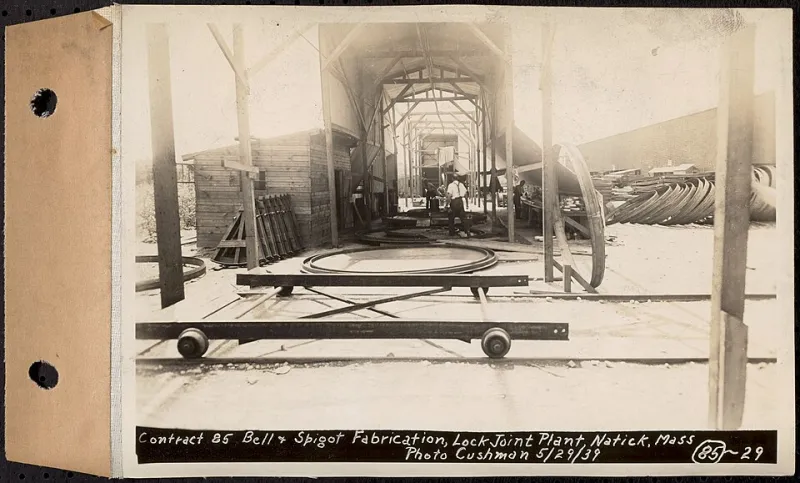
Photo: Massachusetts. Metropolitan District Water Supply Commission, Cushman, Allerton R., 1907-1999, Public domain, via Wikimedia Commons
Bespoke steelwork rarely fails because a buyer forgot to request a certificate. It more often fails because the certificate was requested, supplied and filed without anyone asking what it actually demonstrated. On a fabricated order, execution class documentation is not a single document but a chain of evidence. Each link answers a different question: was the joint designed and made for this duty, was the person who made it competent to do so, was the work inspected at the right moments, and can the steel in the finished member be traced back to its source? Understanding that chain is the difference between treating EN 1090 paperwork as a box-ticking exercise and using it as a procurement tool.
Begin with duty, not with a class number
Execution classes are frequently specified at enquiry stage as though they were a badge of quality. In practice, the class should follow from the consequence of failure, the complexity of the detail, the service conditions and the relevant design assumptions. A straightforward access platform in a sheltered industrial bay does not carry the same execution requirements as a primary member in a heavily loaded structure, a dynamically loaded support, or a fabrication with complex welded connections.
The practical risk runs in both directions. Specify too low and the documentation may not support the duty the structure actually performs. Specify too high and the buyer pays for inspection regimes, qualification records and hold points that the work does not need. A useful discipline is to ask the designer or specifying engineer to state why the chosen class is appropriate, rather than accepting a class number copied from a previous project. That single question often prevents both under-specification and quiet over-specification.
What the welding paperwork actually proves
A welding procedure specification, supported by a procedure qualification record, is evidence that a proposed welding approach has been tested and found capable of producing the required joint properties within a defined range of variables. It is not a guarantee that every production weld will be perfect. It is a statement that the method, consumables, preheat, interpass controls and essential variables have been considered and qualified.
Welder qualification records sit alongside that evidence. They show that the individual or operator has demonstrated competence for the process, material group, thickness range and joint configuration concerned. For a trade buyer, the important point is not simply that certificates exist, but that they cover the work being carried out. A welder qualified for a particular thickness or position may not be qualified for every joint on a bespoke order. The fabricator should be able to map qualifications to the actual production welds without ambiguity.
The inspection and test plan as a schedule of evidence
An inspection and test plan, or ITP, is sometimes reduced to a list of signatures. Read properly, it is a schedule of what will be checked, by whom, at which stage, and against what acceptance criteria. It should identify hold points where work cannot proceed without review, witness points where the buyer or their representative may attend, and review points where records are examined. For a bespoke order, the ITP is where the buyer can see whether the fabrication sequence has been thought through rather than improvised.
The ITP also exposes the difference between inspection and verification. Dimensional checks, weld visual inspection and any required non-destructive testing generate records, but those records only add value if they are tied to defined acceptance criteria and, where relevant, to the correct stage of manufacture. A test performed after a joint has been closed out or coated may not provide the same assurance as one performed at the intended hold point.
Traceability from mill certificate to finished member
Material traceability is the part of the dossier that receives least attention until something goes wrong. Its purpose is to connect the steel used in a member or weldment to the relevant material certificates and, where required, to the specific heat or batch. On a bespoke fabrication, traceability should survive cutting, assembly, welding and surface treatment. A mill certificate for steel delivered to the workshop is not, by itself, traceability of the finished item.
The level of traceability should match the specification and the duty. For many ordinary fabrications, a clear route from certificate to production batch or marked component is sufficient. For more critical work, the requirement may extend to individual heat identification and recorded transfer of markings. The buyer does not need to demand the most exhaustive system on every order, but they should know which level they are paying for and confirm that the fabricator can maintain it through the manufacturing sequence.
Where over-specification quietly adds cost
Over-specification rarely appears as a single line on a quotation. It arrives as extra non-destructive testing on joints that do not require it, additional welder qualification for processes already covered, extended traceability beyond the duty of the structure, or hold points that cause the workshop to stop and wait for reviews that add no meaningful assurance. Each item may seem modest in isolation; together they lengthen the programme and consume inspection capacity.
The more subtle cost is procedural. Every unnecessary hold point creates a dependency on a third party, and every additional record creates an administrative burden that must be checked and compiled. A specification that is demanding without being purposeful can make a straightforward fabrication order slower and more expensive without improving the finished steelwork. The aim is not minimal documentation; it is documentation proportionate to the risk and the duty.
Questions worth asking at enquiry stage
Before comparing prices, a UK trade buyer can clarify much of the documentation position by asking a few direct questions. Which execution class is specified, and on what basis? Which welding procedures and welder qualifications will apply to the actual joints? What does the ITP treat as hold, witness and review points? What level of material traceability is required, and how will it be maintained through fabrication? Will the fabrication dossier be compiled progressively or assembled at dispatch? And are there any specified inspection requirements that the buyer has not consciously chosen?
These questions do more than test a fabricator's paperwork. They reveal whether the enquiry has been read as a set of technical requirements or as a price request with attachments. A fabricator who can answer clearly at enquiry stage is more likely to produce a coherent dossier at completion.
Reading the dossier with confidence
When the fabrication dossier arrives, it should be read as a narrative rather than a bundle. Does the execution class match the duty described in the specification? Do the welding procedures cover the joints actually made? Are the welder qualifications current and relevant? Does the ITP show the inspections that were planned, and do the records show that they took place? Can the material certificates be linked to the members supplied? Do any non-conformances appear, and how were they closed out?
A dossier that answers those questions gives the buyer something more useful than reassurance. It provides a defensible record of how the bespoke steelwork was made, what was checked, and where responsibility sits. That is what execution class documentation buys when it is specified with purpose: not a thicker file, but a clearer line between the duty of the structure and the evidence that the fabrication was executed to meet it.