Disposition Before Dispute: Agreeing Non-Conformance Routes for Bespoke Metalwork
Inspection failure is a process, not a surprise
For a trade buyer, a failed inspection can feel like a sudden stop. In practice, it is one of the normal control points on a bespoke fabrication order. A non-conformance report, usually shortened to NCR, is the formal record that a delivered item, a weld or a finish does not meet the specified requirement. The important question is not whether a departure will occur. On custom steelwork, with unique geometry and interfaces, the more useful question is whether the route from detection to close-out was agreed before the first plate was cut.
A well-run NCR does not assign blame. It establishes facts, identifies the requirement that was missed, and proposes a disposition. The commercial risk sits in the gap between those steps. If the buyer and fabricator have not agreed who decides, how quickly, and at whose cost, a technical issue becomes a programme and payment dispute.
Where non-conformances arise on bespoke metalwork
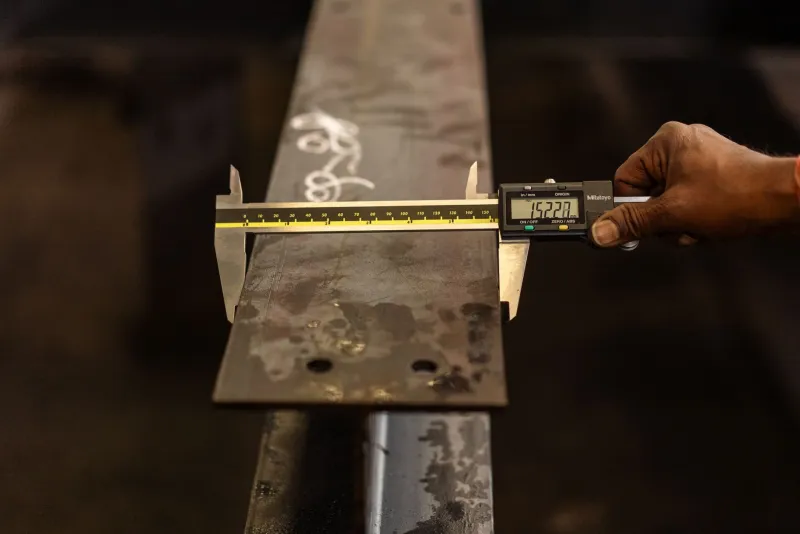
Most NCRs on bespoke orders fall into a small number of families. Dimensional non-conformances include hole positions, member lengths, twist, camber and interface dimensions that do not match the drawing or the surveyed setting-out. Weld non-conformances include undercut, lack of fusion, porosity, incorrect leg length, and procedure or qualification records that do not align with the work performed. Finish non-conformances include galvanised coating thickness, surface preparation, paint adhesion and colour variation.
Documentation matters too. Missing mill certificates, incomplete welding qualification records or broken traceability can stop a package just as effectively as a distorted frame. Each type has a different natural disposition route. Treating them all as a generic defect invites delay, because the decision-maker and the evidence required are not the same.
The disposition routes, defined
The first route is use-as-is, often expressed as a concession. The item is accepted without physical change, usually with engineering justification and formal approval from the buyer or design authority. It is not a workshop decision alone, and it should not be treated as a quiet way to avoid rework.
The second is repair. This restores the item to the specified requirement through a localised action, typically a weld repair followed by re-inspection. Repair needs its own procedure where the original specification requires it, and the close-out evidence should show that the repaired area meets the acceptance criteria.
The third is rework. This brings the item back to the drawing by re-machining, re-forming, re-drilling or re-fabricating part of an assembly. Rework is often the correct route for dimensional departures where the interface cannot be adjusted on site.
The fourth is regrade. The item is accepted to a lower specification where the design and the buyer permit it. This route is less common on structural packages, but it can be relevant to secondary steelwork or non-structural components. It must be documented, not agreed verbally.
The fifth is scrap and remake. This is the correct decision when rework is uneconomic, risks further quality loss, or cannot restore the required properties. Scrap decisions need clear cost allocation for material, labour and programme impact.
Set the inspection regime before the order is placed
The most effective defence against a disputed NCR is an inspection and test plan agreed at enquiry or award stage. The plan should identify hold points, witness points and review points, and it should state the standard against which each item will be judged. For structural steelwork, that usually means the relevant execution class under BS EN 1090-2. Weld acceptance criteria should reference BS EN ISO 5817. Hot-dip galvanising should reference BS EN ISO 1461, and painted finishes should reference the specified system and test methods.
Dimensional tolerances should be stated, not assumed. The plan should also name the inspection authority: fabricator quality control, the buyer, or an independent third party. Notice periods and access arrangements belong in the same document. If a hold point is missed because the buyer's inspector was not available, the order should say whether work may proceed and how the release is recorded.
Agree response times, not just requirements
An NCR without a response clock becomes a storage and standing-time problem. The order should set working-day targets for acknowledgement, disposition proposal, buyer or design authority decision, and close-out evidence. A dimensional query may be resolvable within two working days. A weld repair procedure, or a concession affecting structural capacity, may legitimately need longer. The point is to make the clock visible.
The order should also state what happens if the buyer does not respond within the agreed period. Can the fabricator proceed on a provisional basis? Who carries the risk if the provisional route later changes? These questions are easier to answer before fabrication than after a member has been set aside in the yard.
Cost responsibility: follow cause, but fix the mechanism
Cost allocation should follow cause. A fabrication error is not the same as a design change, a buyer-supplied material issue, or a late change in requirements. Cause can be contested, however, so the mechanism matters as much as the principle. Agree rates for rework labour, re-inspection, transport and accelerated working. Agree how scrap is valued. State whether a concession carries a price adjustment or a credit, and record that in the disposition rather than negotiating after dispatch.
A concession is not automatically free. It may reduce the fabricator's cost but transfer a maintenance or interface risk to the buyer. A formal disposition should say so. The cheapest NCR is the one closed before it affects the programme.
Record the outcome in the completion pack
Every NCR should close with evidence. That may be a revised drawing, a re-inspection report, a signed concession, a non-destructive testing record or an updated as-built. For structural steelwork, concessions and repairs should be traceable to the relevant member or assembly. A completion pack that omits concessions is not complete. It merely postpones the question to site, where access and inspection are harder and the commercial pressure is greater.
A short clause set for the enquiry
- An inspection and test plan with hold and witness points, issued before fabrication.
- A named inspection authority and a defined notice period.
- An NCR issued within one working day of detection.
- A disposition proposal within two working days, and a buyer decision within two working days.
- Agreed rates for rework, re-inspection and transport.
- Clear rules for scrap valuation and concession cost adjustment.
- A defined close-out record for the completion pack.
Conclusion
Bespoke metalwork carries an inherent risk of departure from specification. That is not a criticism of the sector; it is a consequence of unique geometry, multiple interfaces and manual processes. The trade buyer who agrees the disposition route in advance turns a failed inspection into a controlled event. The objective is not to eliminate non-conformances. It is to ensure that when one arises, the technical and commercial response is already understood by both parties.