Settling the Fire Case Before the Saw Starts: Intumescent Systems on Bespoke Steel Orders
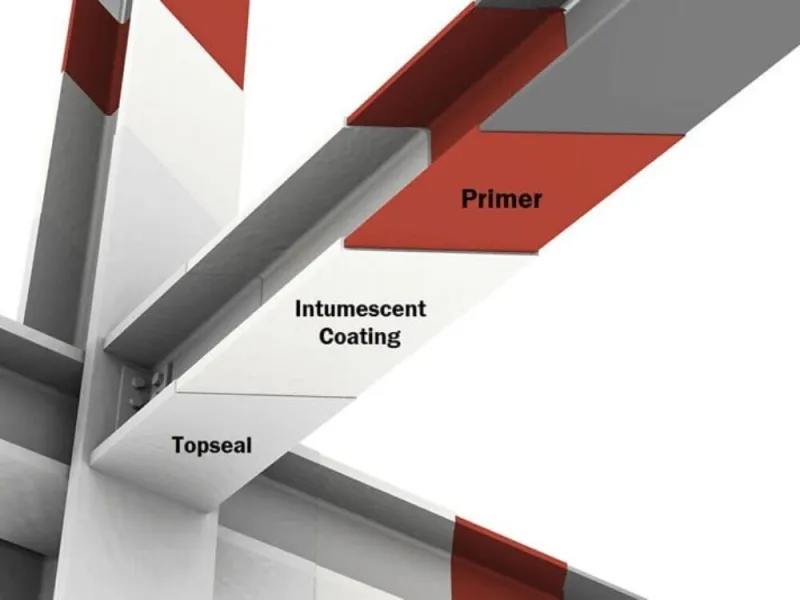
Photo: intumescent coated structural steel beams fabrication workshop UK, via indukote.ca
On a bespoke steel package, fire protection is frequently discussed as a finishing trade: something that follows fabrication, arrives with a specialist applicator and is recorded at the end of the job. That sequence is understandable, but it is not always commercially safe. By the time the steel is cut, drilled and welded, the fire strategy may already have fixed the required resistance period, the section factor, the primer system and the evidence needed at handover. If those points are left open, the fabricator is asked to absorb uncertainty that belongs earlier in the process.
For UK trade buyers, the practical question is not simply which intumescent product will be used. It is whether the fire case has been settled early enough to influence drawings, tolerances, handling and inspection. A fabricator such as Apcemmert Metal Fabricators can fabricate to a clear protection regime; it cannot invent one after the steel has been primed with an incompatible system.
Fire resistance is a design input, not a coating afterthought
The required fire resistance period should be stated at enquiry stage, not discovered when the fire strategy is issued for construction. In UK practice, periods of 30, 60, 90 and 120 minutes are common, but the number itself is only the start. The buyer should confirm which members require protection, whether the requirement applies to the whole section or to specific faces, and whether there are any elements exempted by the fire engineering approach.
This matters because intumescent protection is not a universal coating. It is a tested system with limits. The product data sheet will state the scope of the fire test, the steel section range, the maximum section factor and the primers or topcoats with which the system has been assessed. A buyer who issues a performance requirement without those boundaries is inviting a substitution argument later.
The section factor sets the demand
The section factor, usually expressed as A/V or Am/V, describes the ratio of the heated perimeter to the steel volume. Put simply, slender sections heat up faster than stocky ones, and the intumescent coating has to work harder to hold the steel below its limiting temperature. The required dry film thickness follows from that ratio, together with the fire resistance period and the limiting temperature adopted in the structural fire design.
For bespoke fabrication, the implication is straightforward: the section factor must be calculated for the actual sections being used, not for a generic beam or column. If the design changes during fabrication, the coating demand can change with it. A heavier section substituted for a lighter one may reduce the coating thickness; a change in orientation or fire protection scope may increase it. The fabricator needs the final section schedule and the fire protection schedule to be aligned before priming and coating decisions are locked.
Primer compatibility is not a formality
Intumescent coatings are applied over a primer, and the primer is part of the tested system. A zinc phosphate shop primer that suits one product may be unacceptable to another. An epoxy primer may be compatible with a solvent-borne intumescent but not with a water-borne alternative. The buyer should not assume that the fabricator’s standard primer is acceptable simply because it is a good anti-corrosion primer.
The safest route is to obtain a written compatibility statement from the intumescent manufacturer before fabrication begins. That statement should identify the primer by product name and generic type, the surface preparation standard, the maximum primer thickness and any restrictions on application over weld seams, sharp edges or previously coated steel. If the primer is changed, the compatibility position should be rechecked rather than assumed.
Scope split: who applies, who inspects, who records
On many bespoke steel packages, the intumescent application is carried out by a specialist applicator rather than by the fabricator. That split can work well, but only if the responsibilities are defined. Who purchases the intumescent? Who confirms the product is suitable for the section factor and fire period? Who inspects surface preparation? Who records dry film thickness readings? Who signs off touch-up after handling? Who assembles the handover file?
These questions should be answered in the enquiry pack, not left to a site meeting. The buyer should also confirm whether independent inspection is required and at what stage. If third-party inspection is specified, the fabricator and applicator need to know the hold points: before priming, before intumescent application, after the top seal coat and before dispatch. Inspection that arrives after the beams are wrapped is rarely useful.
Fabrication, handling and finish sequencing
Intumescent coatings are softer than the steel beneath them. They can be damaged by slings, chains, temporary supports and repeated handling. The specification should therefore address protection during fabrication and transport, not only the applied thickness. Bolt holes, contact surfaces and areas that will be welded on site may need masking or specific treatment. The fabricator needs to know which surfaces are to remain uncoated and how those boundaries will be marked.
Finish sequencing also deserves early attention. If a top seal coat is required, it should be compatible with the intumescent and applied within the manufacturer’s window. If the steel is to be galvanised, the intumescent system must be suitable for that substrate and the galvanising process must be completed before coating. Hot-dip galvanising after intumescent application is not a sequence that can be reversed.
What to settle at enquiry stage
The most effective time to resolve these issues is before the drawing office releases fabrication drawings. At that point, changes are still drawing changes rather than cutting, coating and rework. The buyer should provide the fire resistance period, the fire protection schedule, the final section schedule, the primer specification and the required handover evidence. The fabricator can then confirm what is practical, what needs masking and where the scope boundaries sit.
A short checklist for the enquiry pack
- Required fire resistance period for each member type, stated in minutes.
- Section factor calculation for the actual sections, including any substitutions.
- Intumescent product or system performance criteria, with test standard and scope.
- Primer product name, generic type and maximum thickness, with compatibility confirmation.
- Whether application is by the fabricator or a specialist applicator, and the scope split.
- Inspection regime, hold points and whether independent inspection is required.
- Masking requirements for bolt holes, contact surfaces, site welds and uncoated areas.
- Topcoat or seal coat requirements, including compatibility and application window.
- Touch-up procedure and responsibility after handling, transport and erection.
- Handover records: batch certificates, application records, dry film thickness readings and inspection sign-offs.
None of these points is exotic. Together, they determine whether the fire protection is a controlled part of the bespoke steel package or a late negotiation. Settling the fire case before the saw starts is not an additional burden on the buyer; it is the point at which the specification becomes buildable.