The Measure of a Weld: Planning for Shrinkage in Bespoke Steelwork
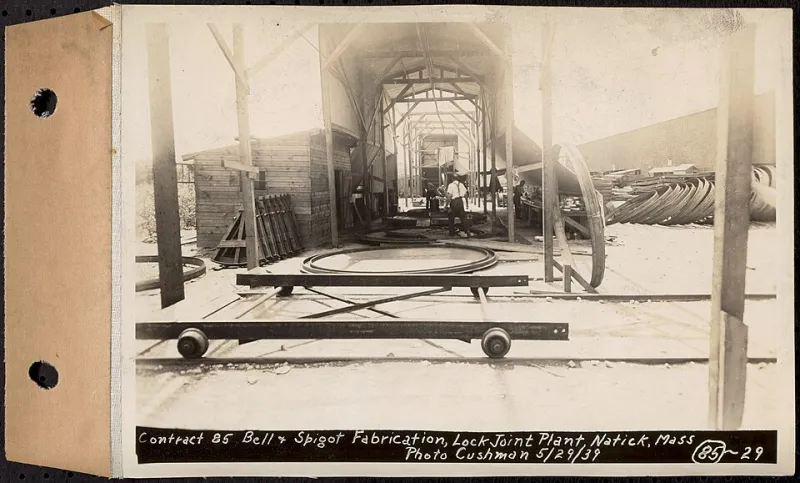
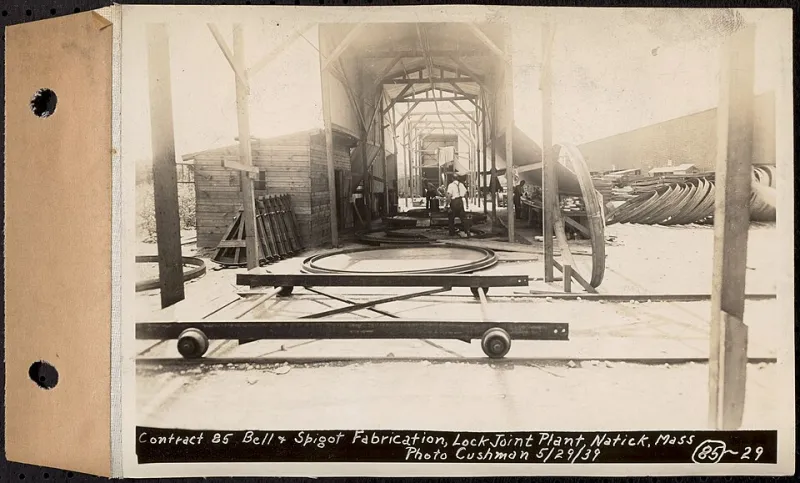
Photo: Massachusetts. Metropolitan District Water Supply Commission, Cushman, Allerton R., 1907-1999, Public domain, via Wikimedia Commons
A welded fabrication rarely finishes exactly where the drawing placed it. The heat of welding introduces contraction, and contraction introduces movement. In bespoke steelwork, the useful question is not whether a frame, stair or balustrade will move, but whether that movement has been anticipated, controlled and inspected. For trade buyers, distortion is both a quality issue and a commercial one. It affects fit-up on site, the cost of remedial work and the programme between workshop dispatch and installation.
Distortion is often treated as a workshop matter to be resolved with a straightening press or a flame torch. In practice, many of the most important decisions are made much earlier, at the drawing stage and in the procurement conversation. A fabrication that has been detailed with shrinkage in mind is easier to build, easier to inspect and less likely to generate a dispute when it reaches the galvaniser or the site compound.
Shrinkage begins in the drawing office
Every weld deposits molten metal that cools and contracts. The contraction is small in a single fillet, but it accumulates across a fabrication. Where the surrounding steel restrains that contraction, residual stress builds up. Where it does not, the workpiece bows, twists or pulls out of square. The pattern is predictable enough to be designed around, but only if the drawing office treats weld detail as a manufacturing instruction rather than a symbolic requirement.
The first control is weld size. A fillet weld specified larger than the design case requires adds heat input, consumable and shrinkage without adding useful strength. Over-welding is common in bespoke work because it feels conservative. In reality, a leaner weld that satisfies the joint design is often the more controlled choice. Similarly, joint preparation should be clear enough that the workshop is not forced to compensate for poor fit-up with excess weld metal.
Drawing details should also consider symmetry and restraint. Welds placed close to the neutral axis of a section tend to produce less bowing than welds concentrated on one face. Stiffeners and cleats that sit eccentrically can pull a member out of line. Where a critical face will later be machined or drilled, a machining allowance may be needed rather than an expectation that the welded assembly will arrive flat. These are drawing-office choices with direct workshop consequences.
Weld size, sequence and restraint
Sequence is the workshop lever that turns drawing intent into dimensional control. Balanced welding, backstep techniques and staggered runs distribute heat more evenly than a single continuous pass along one side of a member. Tack welds should be treated as part of the welding sequence, not as a temporary inconvenience. If they are placed poorly or left too small, they can pull the assembly before the main welds begin.
Fixturing is equally important, but it is not a substitute for good sequencing. A strong jig can hold a fabrication in position while it is welded, yet excessive restraint can lock residual stress into the finished item. When the clamps are released, the steel may move. The aim is controlled restraint, sufficient to hold critical dimensions without turning the fixture into a battle between the jig and the cooling weld.
For thicker sections, preheat and interpass controls may be required by the procedure. These are not merely metallurgical measures; they also influence how heat moves through the fabrication. A fabricator that can explain its intended sequence, fixturing and pre-set allowances is demonstrating that distortion has been considered before the first arc is struck. That explanation is worth more than a vague assurance that the workshop will 'keep it straight'.
Straightening is a process, not a rescue
Some movement is normal, and realistic fabrication schedules allow for it. Press straightening or controlled flame straightening can bring a member back within tolerance, but these operations need method, competence and inspection. They should not be improvised after a dimensional problem is discovered at the end of the job. Nor should they be treated as free. Straightening consumes labour, can affect surface condition and may require subsequent non-destructive examination depending on the item and specification.
The commercial risk rises sharply after galvanising. Hot-dip galvanising involves heating the steel again, and that thermal cycle can relieve locked-in stresses and allow movement to appear. A fabrication that was dimensionally acceptable before coating may not be acceptable after it. If straightening is then required, the zinc coating will be damaged and will need repair in accordance with the relevant coating standard. The cost is no longer a workshop cost alone; it becomes a coating repair, a programme delay and possibly a site issue.
Inspection points that earn their keep
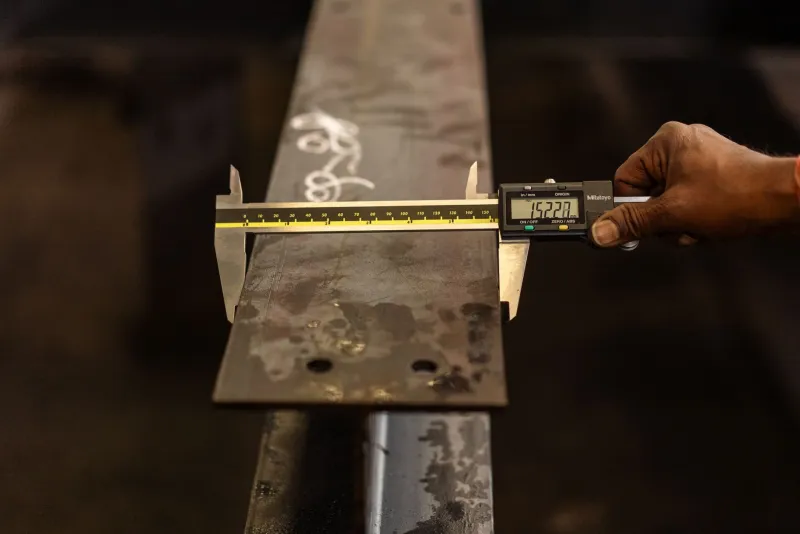
Dimensional inspection should be planned around the points where movement can still be influenced. Checking after tacking, after welding and cooling, and before surface preparation gives the workshop a chance to correct the fabrication while it is still in a workable condition. A final check before dispatch is necessary, but it is too late to be the only check.
For trade buyers, the enquiry should identify critical dimensions and interfaces: base plate positions, bolt hole centres, connection faces, stair rises and balustrade setting-out points. The applicable tolerance standard, often BS EN 1090-2 for structural steelwork, should be agreed rather than assumed. Hold points for inspection and recorded results should be stated where the item is complex or the interface is tight. On retrofit work, the survey information and the agreed tolerance envelope deserve particular attention, because the steel has to fit an existing building rather than an ideal one.
Buying distortion out of the job
Distortion control is easier to procure than to argue about later. A request for quotation can ask how the fabricator intends to manage weld shrinkage, what straightening allowance has been included, which inspection points will be recorded and how coating damage will be repaired if remedial work is needed. These questions do not require a lengthy technical submission, but they reveal whether the price has been built on a realistic method.
The lowest quotation may appear attractive until distortion is discovered after galvanising or delivery. At that point, the cost of rework, transport, site labour and lost programme usually outweighs any saving made at award. A fabrication that arrives within tolerance is not simply the product of a careful welder. It is the result of drawings that specify sensible weld details, a workshop sequence that controls heat and restraint, inspection at the right moments, and a buyer who has agreed what acceptable movement looks like before the steel is cut.