Cut to Fit the Job: Selecting Profiling Methods for Bespoke Metal Components
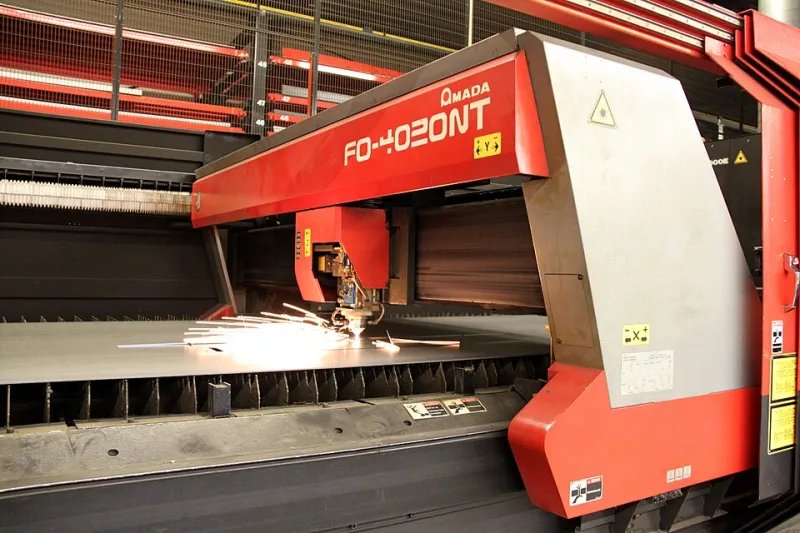
Photo: Metaveld BV, CC BY-SA 3.0, via Wikimedia Commons
The cutting route is part of the specification
A profiling line on a fabrication quotation can look deceptively simple: a price per component, perhaps a set-up charge, and a lead time. In practice, the selected cut process influences far more than the shape that arrives at the welding bench. It affects edge quality, hole geometry, dimensional consistency, heat input, nesting efficiency and the amount of secondary work needed before a bespoke metal component is ready for assembly or finish.
For trade buyers, understanding that relationship is useful commercially. It makes quotations easier to compare, drawing queries more focused and technical discussions with a fabricator more productive. At Apcemmert Metal Fabricators, profiling is treated as an engineering choice rather than a commodity line item, because the right route depends on the material, thickness, tolerance and eventual service of the part.
Laser cutting: precision where the thickness allows
Fibre laser cutting is often the default choice for sheet metal components that require fine features, repeatable hole patterns and a clean edge. It is well suited to mild steel, stainless steel and aluminium in thinner gauges, and it can hold close tolerances across production runs without excessive manual intervention.
From a buyer’s perspective, the advantages are usually visible in three places. First, small holes and narrow webs can be produced with less risk of distortion than with some alternative processes. Second, the heat-affected zone is generally narrow, which helps where edge condition matters for subsequent welding, painting or powder coating. Third, nesting can be efficient on sheet material, particularly when several components share a common gauge and finish.
Laser cutting is not automatically the cheapest route for every thickness. As material gauge increases, cutting speeds fall and the process can become less economic than plasma for structural plate work. Very thick sections may also fall outside the capability of a particular subcontractor’s machine, even if the process is theoretically possible. A quotation that names laser cutting should therefore be read alongside the material grade, thickness range and any stated edge or tolerance requirement.
Plasma cutting: capacity and speed at greater thickness
Plasma cutting is frequently used for thicker mild steel plate, structural brackets, base plates and general fabrication components where speed and capacity matter more than a finely finished edge. Modern high-definition plasma systems can produce good quality cuts on a range of metals, but the process remains distinguishable from laser in terms of kerf width, edge squareness and heat input.
The heat-affected zone is a practical consideration. On thicker sections, plasma cutting can leave a harder edge and a marginally wider zone of thermal influence. For many structural or non-aesthetic parts this is acceptable, provided the fabricator accounts for it in downstream operations. Where the edge will be welded, machined or painted, the purchaser should confirm whether dross removal, grinding or edge preparation is included.
Plasma also has a role where the component is large and the nesting strategy favours plate rather than sheet. A trade buyer comparing quotes may find that one supplier proposes laser cutting for a 15 mm bracket while another proposes plasma. Neither is necessarily wrong; the better question is which process meets the drawing requirement at the stated tolerance and finish, and whether the quoted price includes the secondary work needed to achieve it.
Waterjet: cold cutting for heat-sensitive and mixed-material work
Abrasive waterjet cutting removes material without the thermal input associated with laser or plasma. That makes it valuable for thicker sections, heat-sensitive materials, stacked sheets and components where distortion or metallurgical change at the edge must be minimised. It is also useful where a workshop needs to cut mixed materials on the same programme without resetting a thermal process.
The trade-off is usually speed and consumable cost. Waterjet cutting is slower than laser on thin sheet, and the abrasive garnet, nozzle wear and disposal arrangements contribute to the operating cost. Edge quality can be very good, but taper and surface finish depend on cutting speed, material thickness and machine set-up. For bespoke metalwork, waterjet is often specified where a cold cut is a genuine technical requirement rather than a general preference.
A buyer reviewing a quotation should look for any secondary machining or finishing allowance. Waterjet-cut edges may still require deburring or preparation before welding, and the absence of a heat-affected zone does not remove the need for inspection against the drawing.
Reading the profiling line in a fabrication quote
A useful quotation should identify more than the process name. It should make clear the material grade and thickness, the proposed cutting method, the dimensional tolerance, the edge condition and any included secondary operations. Where a drawing specifies a particular hole size, minimum radius or weld preparation, the fabricator should confirm whether the chosen process can achieve it economically and consistently.
Buyers should also ask whether the quoted process is fixed or indicative. A supplier may price a component on laser cutting but later propose plasma if the thickness or quantity changes. That is not necessarily a problem, provided the change is agreed before production and the implications for edge quality and downstream work are understood. The comparison should be between delivered, fit-for-purpose components, not between headline cutting rates.
Nesting efficiency is another factor that can explain price differences. A component with an awkward shape may generate more scrap on one process or machine format than another. Similarly, a small batch may carry a disproportionate set-up cost regardless of the cutting method. For repeat bespoke work, it is reasonable to ask how the supplier intends to nest the parts and whether common-line cutting or tabbing will be used.
Drawing details that steer the decision
Several drawing characteristics tend to point towards one process. Very small holes relative to material thickness, tight internal radii and fine cosmetic edges generally favour laser or, in specific cases, waterjet. Heavy plate with generous radii and structural tolerances may suit plasma. Parts that must avoid thermal distortion, or that combine materials with different thermal responses, may justify waterjet despite a higher piece price.
The key is to avoid over-specifying a process in isolation. A drawing that demands a particular cut method without stating the functional reason can restrict the fabricator’s ability to offer a competitive route. A better approach is to specify the performance requirement — edge finish, tolerance, hole geometry, heat input limit — and allow the fabricator to propose the process that meets it.
Downstream consequences matter
Cut quality follows the component into welding, finishing and inspection. A rough plasma edge may require additional grinding before a weld is made, while laser-cut oxide on mild steel can affect paint preparation if it is not removed. Waterjet-cut parts may carry abrasive residue that needs cleaning before coating. None of these issues is unusual, but each should be priced and planned rather than discovered at the end of the job.
For UK trade buyers, the practical lesson is to treat profiling as an engineering decision with commercial consequences. The cheapest cutting line is not always the lowest total cost once edge preparation, distortion control and finishing are included. A fabricator that can explain why a process was selected — and what it means for the delivered component — is usually easier to hold to account than one that simply quotes a rate per metre.